
admin@hepacleanroomfilter.com
The production of active pharmaceutical ingredients usually employs multiple standard chemical process systems, typically operated in batch mode: the materials are loaded into reactors, undergo reactions in solutions or suspensions, then the products are dried and separated, and collected in sealed containers for further chemical processing or as the final product - the active pharmaceutical ingredient. The active substances may exist at all stages of the process, such as raw materials, chemical intermediates, or the final active pharmaceutical ingredient. These materials can also be in different forms, including solids, liquids, and mixed solutions. Each stage and operation requires careful assessment of the sealing requirements.
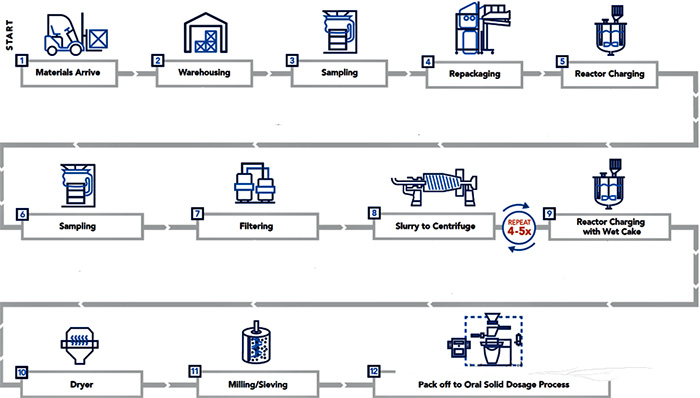
Active Pharmaceutical Ingredients production process
The chemical production process is usually a multi-step process, using multiple containers to complete reaction conversion, separation and purification of liquid intermediates and products, crystallization or precipitation of solids, and separation and/or drying of solids. These processes are typically carried out in separate containers or production equipment, and each process has different containment challenges, especially when corrosive chemicals and solvents are present, and they are usually conducted under high temperature and high pressure conditions.
In the production of pharmaceutical raw materials, the starting raw materials/intermediates are added to the reaction process, which may include multiple consecutive synthesis steps. The starting materials can be directly added to the reactor from the feeding isolator through the transfer container, or they can be first transferred to the intermediate container in the filling chamber, and then transferred to the reactor through the intermediate container.
Reactor vessels are usually closed systems that can withstand high temperatures and pressures. During normal operation, they can be considered "closed". Exposure mainly occurs during the intervention processes of the reactor, such as adding solid raw materials to the reactor, sampling, and transferring the contents of the reactor to another container. Adding active raw materials to the reactor or generating aerosols containing these active substances during the process may cause contamination of the exhaust pipes of the reactor. Therefore, it is necessary to pay attention to ensuring that these areas are effectively cleaned, and in the places where filters are installed, the filters should be able to be safely replaced or automatically cleaned.
The flat-head reactor is easy to clean.
Reactor features:
Volume range: 1 - 20000L
Materials: glass, glass-lined low-carbon steel, stainless steel, special alloys;
Functions: stirring, heating and cooling, pressurization, introduction of inert gas, distillation, phase separation (extraction), transfer;
Applications: reaction, crystallization, extraction, neutralization
