Differences and Comparison Between Modular Cleanroom and Cleanrooms
I. Different Definitions
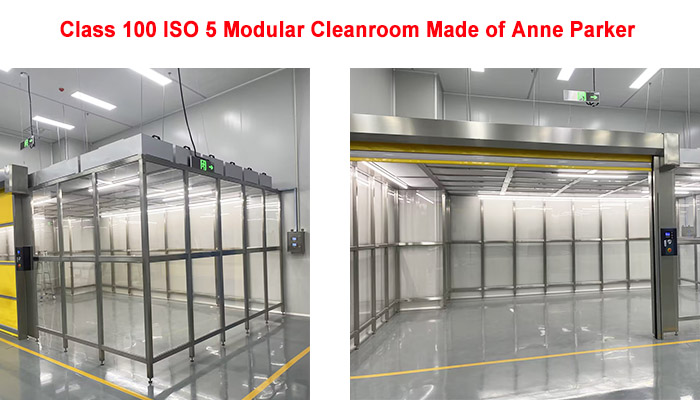
- A modular cleanroom, also known as a cleanroom booth (dust-free booth, purification booth, operating workbench, etc.), refers to a small space enclosed by anti-static grid curtains or acrylic glass in a clean room. The upper part uses HEPA (High-Efficiency Particulate Air) filters and FFU (Fan Filter Unit) air supply units to form a space with a higher purification level than the clean room. Clean booths can be equipped with purification equipment such as air showers and pass-through boxes.
- A cleanroom is a specially designed room that removes pollutants such as micro-particles, harmful air, and bacteria from the air within a certain space range, and controls the indoor temperature, cleanliness, indoor pressure, air velocity and air distribution, noise and vibration, lighting, and static electricity within a certain required range. That is to say, regardless of changes in external air conditions, the room can maintain the originally set performance characteristics such as cleanliness, temperature and humidity, and pressure. The main function of a clean room is to control the cleanliness level, temperature and humidity of the air that comes into contact with products, so that products can be produced and manufactured in a good environmental space. Such a space is what we generally call a clean room.
II. Material Comparison
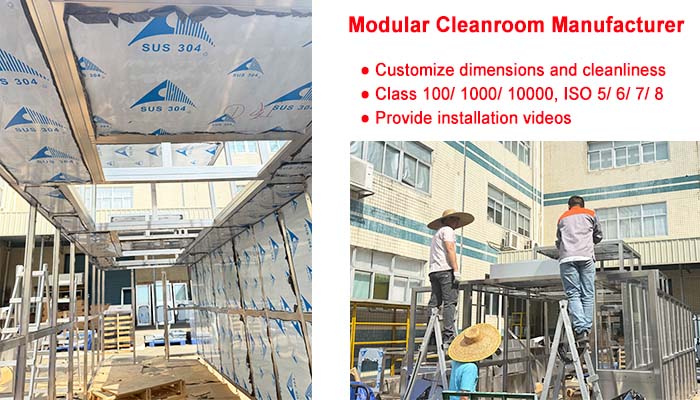
- The frame of a modular cleanrrom booth can generally be divided into three types: stainless steel square tubes, painted iron square tubes, and industrial aluminum profiles. The top can be made of materials such as stainless steel plates, painted cold-formed steel plates, anti-static grid curtains, and acrylic glass. The surrounding area is usually made of anti-static grid curtains or acrylic glass, and the air supply part is all equipped with FFU clean air supply units.
- A cleanroom generally uses foam color steel or rock wool boards for suspended ceilings and vertical walls, and is equipped with an independent air-conditioning air supply system. The air undergoes primary, intermediate, and high-efficiency three-stage filtration. For personnel and materials, it is equipped with air showers and pass-through boxes for clean filtration.
III. Selection of Clean Booth Purification Level
Most customers will choose Class 1000 or Class 10000 cleanroom booths, while a small number of customers will choose Class 100 or Class 10000. In short, the selection of the cleanroom booth level depends on the customer's cleanliness requirements. However, because clean booths are relatively airtight, if a clean booth with a relatively low level is selected, it will often bring some side effects: insufficient cooling capacity, and employees will feel relatively stuffy and hot inside the clean booth. Therefore, in the actual communication process with customers, this point needs to be noted.
IV. Cost Comparison Between Modular Cleanroom Booths and Dust-Free Workshops
- Cleanroom booths are usually built in clean rooms, so there is no need to consider air showers, pass-through boxes, and air-conditioning air supply systems. The cost is significantly lower than that of clean rooms. Of course, this is related to the materials used, size, and cleanliness level of the clean booth. Some customers will build clean booths in dust-free rooms, but some customers do not want to build independent dust-free workshops. If the clean booth does not include air-conditioning systems, air showers, pass-through boxes, and other purification equipment, the cost of the clean booth is approximately 40% to 60% of the cost of a dust-free workshop. This depends on the customer's choice of clean booth materials and the size of the clean booth. The larger the area that needs to be clean, the smaller the cost difference between the clean booth and the dust-free workshop.
V. Advantages and Disadvantages
1. Advantages and disadvantages of modular cleanroom booths:
A) Clean booths have fast construction, low cost, easy disassembly and assembly, and can be reused;
B) Since the height of a clean booth is usually about 2 meters, using a large number of FFUs will result in high internal noise;
C) Since there is no independent air-conditioning air supply system, the interior of the clean booth will often feel stuffy and hot;
D) If the modular cleanroom booth is not built in a clean room, due to the lack of filtration by intermediate-efficiency air filters, the service life of high-efficiency filters will be shorter than that in a clean room. Such frequent replacement of high-efficiency filters will increase the cost.
2. Advantages and disadvantages of clean rooms:
A) Clean rooms have slow construction and high cost;
B) The height of a clean room is usually about 2600mm, so employees will not feel depressed when working inside.